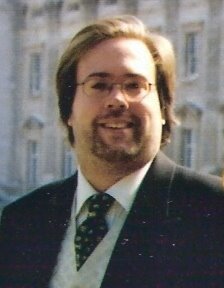
The spring dates for the AghaRTA Prague Jazz Festival are now out. The concerts will take place (as usual) at the Lucerna Music Bar: a great relaxed venue with very reasonably priced beer.
Acts appearing this year include the John Scofield Quartet (27/4), Courtney Pine (9/2), and the rockers-who-can-jazz-a-bit supergroup Bozzio/Holdsworth/Levin/Mastelotto (23/4).
Full details are available here.
Showing posts with label AghaRTA. Show all posts
Showing posts with label AghaRTA. Show all posts
Tuesday, December 22, 2009


Thursday, July 30, 2009
Gig Review: Rhythm Desperados

AghaRTA Jazz Centrum
28th July 2009
Turning on the television or reading a newspaper can bring you down. Swine flu, terrorism, floods, droughts, economic chaos, unemployment, the enduring appeal of Oasis: everything's total rubbish. Sometimes it feels like there is no fun left in the world. But then something comes along to remind you that, against all odds, there actually there is: Rhythm Desperados.
This is not a reversal of policy at PJHQ - we're still music snobs of the highest order - but outfits that can combine excellent original writing, interesting arranging, superb playing, and still fool around on the stage joyously are sadly few and far between. As such they deserve all the attention they can get.
The band is based round a core of Boris Urbánek (keys), Michal Žáček (saxes and flute) and Michal Hejna (drums). Bass and percussion duties are more flexible, with Martin Lehký and Pavel Plánka often filling the roles but for this gig it was Imran Musa Zangi hitting things like a nutter and Wimpy Tichota taking care of the low end. All of them are fine musicians, playing in a wide variety of bands. When they come together as Rhythm Desperados it is almost a “supergroup” of modern Czech jazz, although the term is not really correct. Supergroups tended to collapse under the weight of their own egos and the whole was often less than the sum of the parts. This is certainly not what happens with this band.
The first set was straight down the line, focusing mainly on original work composed by the talented Urbánek. Žáček leads from the front, an emotive whole-body player who really makes the instrument sing and uses the range of the soprano saxophone well. His solos were intense and instinctive, real crazy knife-edge stuff, but they were always placed naturally into the songs and never uncomfortably stuck on to prove a point. The keyboard solos were pretty intense too, again dispensed with good taste as well as fast fingers.
The rhythm section was certainly not being shown up while all this was going on, playing very fast and very furious. "Volcano" (B. Urbánek) featured both drummer and percussionist thrashing away like mad while tension was built up using synthesiser rumbles and swooshes. Tichota, as well as putting bounce into the funky sound, also had some really sweet moments such as in "First Snow" (B. Urbánek), playing melodic bass runs in unison with rolling piano.
The overall tempo was fast and upbeat, moments of funk and moments of fusion, with some Latin flavours too. It was a good mix of sounds, cohesive but with enough variation to be interesting. There were also gentler times during the show, such as the romantic "Déjà vu" (B. Urbánek), but celebratory rather than contemplative was the order of the day.
The second set was where the fun broke loose. An opening piano and flute duet that deviated into The Big Country. "Sunny" (B. Hebb) was given a lively presentation with gaps left for the audience to sing the “I love you” line. That then turned into a medley that incorporated Für Elise, Bésame Mucho and Popcorn. All with tongue very firmly in cheek of course, the band having previously set out its impeccable artistic credentials and now at complete liberty to screw around. The crowd loved it, although I do wish that audiences in general were as receptive to original, exciting music as they always are to stuff they've heard on the radio.
The club was pretty full considering that it was a midweek gig, and as usual for AghaRTA most people were there to listen. There are always exceptions, in this case a few French persons who drank small coffees and had big mouths. A couple of dirty looks did the trick, and pretty soon they were fully collaborating. But if you want to talk why get a table right at the front, right by the stage? As well as disrupting the music for others it is just rude to the band, an especially odd thing to do when the garlic gang were actually enjoying the show.
The remainder of the evening wasn't just fooling around with familiar numbers: there was more original material to come, including “All Or Nothing”, that Urbánek told us he wrote a quarter of a century ago. Regardless of age it sounded fresh, something that could be said about the Rhythm Desperados in general, and also about their stomping version of “Birdland” (J. Zawinul). Big and meaty, properly loud, and the band having a ball.
Watching this outfit was half the pleasure. Zangi's work on percussion was relentless, only interrupted when he reached down to pull out yet another stick, block, shaker, thing that goes boing, or a cocktail. Žáček's total commitment to his playing was spectacular, and Urbánek is no slouch either; some excellent playing from him as well as a lot of enthusiasm, getting the audience clapping along and generally looking like he was enjoying himself.
The Rhythm Desperados are an interesting and unusual band. There are some groups in this city that pursue creative excellence and there are some that just set out to entertain. These guys prove that the two are not mutually exclusive. It was hard not to be impressed by their musicianship and the original compositions. It was also hard not to smile. Go and see them. It's probably more fun than anything else you've got planned.
Wednesday, July 29, 2009
News: AghaRTA Open Air Concerts
This year's AghaRTA Open Air Concerts will take place on August 1st and 2nd, in the beautiful setting of Prague's Old Town Square. The performances are between 14:00 and 20:00 each day, feature some of the big names of Czech jazz (including Jan Štolba, Štěpán Markovič, Pavel Razím, Rhythm Desperados), and are totally free. These gigs are always a special event so come along if you can.
The full details can be found here.
The full details can be found here.
Monday, June 29, 2009
Viklický / Wellins At AghaRTA
The last night of this CZ-GB mini-tour (28/6) was once again a delight to witness. Bass duties were taken over by Petr Dvorský but otherwise the outfit was the same as before: Emil Viklický, Bobby Wellins and Dave Wickens.
It was probably the tightest of the three performances, loaded with improvisation but always retaining melody and musicality. From the lyrical to the blistering they tore through such exciting material as Caravan (J. Tizol) and the gorgeous Monk's Mood (T. Monk). The lack of repetition over the three dates was truly impressive, with the outfit producing three very different shows.
It was a true privilege and pleasure to see these gentlemen making music together and it is to be hoped that Bobby and Dave pass this way again soon.


(Left to right: Dave Wickens, Bobby Wellins, Petr Dvorský, Emil Viklický, Tony Emmerson)
It was probably the tightest of the three performances, loaded with improvisation but always retaining melody and musicality. From the lyrical to the blistering they tore through such exciting material as Caravan (J. Tizol) and the gorgeous Monk's Mood (T. Monk). The lack of repetition over the three dates was truly impressive, with the outfit producing three very different shows.
It was a true privilege and pleasure to see these gentlemen making music together and it is to be hoped that Bobby and Dave pass this way again soon.


(Left to right: Dave Wickens, Bobby Wellins, Petr Dvorský, Emil Viklický, Tony Emmerson)
Saturday, November 22, 2008
Gig Review: Karel Růžička Trio
AghaRTA Jazz Centrum
15th November 2008
Karel Růžička is one of the heavyweight figures of Czech jazz. Composer, conductor, teacher, former president of the Czech Jazz Society and also, of course, bandleader and pianist, his is a formidable record. His Trio performances are events to be savoured but maybe not always for the faint of heart. They offer up no jazz-lite to give succour to the sort of people who think that Richard Clayderman albums are very exciting. They play hardcore, hardball, and hard hitting modern jazz with their own unique sound.
Central to that sound is Růžička’s piano. His technique is aggressive, and extensive use of his left hand gives it more bottom end than you would normally hear. He is quick and dextrous but at the same time there is a simmering violence that seizes the music into existence, carving and shaping soundscapes into reality like a sonic sculptor. His understanding of the shape and form and colour of music, coupled with his ability to concoct soaring improvisations of dizzying perfection, is a recipe for cool thrills.
Bass duties were assumed as usual by Josef Fečo, who pounded his way up and down the big strings with flair and taste. Drum duties were handled by Martin Šulc who I had not seen with the Trio before and was introduced as a guest player. He contributed an excellent percussive performance, and the virtual telepathy between the three men kept things exciting and fresh.
The opening piano solo, dark and mellow, raised the curtain and led into a bout of the sort of sophisticated ensemble playing that they do so well. Each voice was clear and distinct and had something to say, but like a good conversation they never talked over each other or drowned each other out.
On the previous occasions that I have seen this Trio it was Růžička’s own compositions that seemed to dominate the evening, but this time it was his interpretations of other material that stole the show. A good interpretation is always pleasing to the heart and mind: a familiar phrase placed in a new context, with enough remaining to make the piece recognisable but enough invention to make it a unique composition in its own right. Their rendition of “All Blues” (M. Davis) was a perfect example. The swirling riff of the original was kept intact but alongside it the Trio gave their creativity full reign. The result was a textured and contoured journey, sometimes so gentle that Růžička could add percussion to the sensitive drum solo by tapping his unamplified water glass, and sometimes emphatic and triumphant.
“On Green Dolphin Street” (B. Kaper) was also given a good run though with some dazzling piano runs and “They Can’t Take That Away From Me” (G. Gershwin / I. Gershwin) brought smiles from all around. A prime example of taking a great theme and running with it, it was a sad disappointment that this freewheeling and joyful blast of improvisation ever had to end.
Amid the more robust material there was also outstanding beauty on show. “You Don’t Know What Love Is” (G. de Paul) and “My Funny Valentine” (R. Rodgers) were moving and emotional dips into the Great American Songbook, while “Largo” from Dvořák’s “New World Symphony” brought with it an epic stillness and peace.
A final rattle through of “Oleo” (S. Rollins) dispatched the audience out into the cold night. In some ways it would have been nice to see Růžička’s own material given more prominence, if only to make sure that the passing trade knew that they had seen a great writer as well as great interpreter, but it was still a fine evening of demanding yet listenable jazz. If you haven’t seen them yet, and you like your jazz trios uncompromised and full on, then put them in your diary today.
15th November 2008
Karel Růžička is one of the heavyweight figures of Czech jazz. Composer, conductor, teacher, former president of the Czech Jazz Society and also, of course, bandleader and pianist, his is a formidable record. His Trio performances are events to be savoured but maybe not always for the faint of heart. They offer up no jazz-lite to give succour to the sort of people who think that Richard Clayderman albums are very exciting. They play hardcore, hardball, and hard hitting modern jazz with their own unique sound.
Central to that sound is Růžička’s piano. His technique is aggressive, and extensive use of his left hand gives it more bottom end than you would normally hear. He is quick and dextrous but at the same time there is a simmering violence that seizes the music into existence, carving and shaping soundscapes into reality like a sonic sculptor. His understanding of the shape and form and colour of music, coupled with his ability to concoct soaring improvisations of dizzying perfection, is a recipe for cool thrills.
Bass duties were assumed as usual by Josef Fečo, who pounded his way up and down the big strings with flair and taste. Drum duties were handled by Martin Šulc who I had not seen with the Trio before and was introduced as a guest player. He contributed an excellent percussive performance, and the virtual telepathy between the three men kept things exciting and fresh.
The opening piano solo, dark and mellow, raised the curtain and led into a bout of the sort of sophisticated ensemble playing that they do so well. Each voice was clear and distinct and had something to say, but like a good conversation they never talked over each other or drowned each other out.
On the previous occasions that I have seen this Trio it was Růžička’s own compositions that seemed to dominate the evening, but this time it was his interpretations of other material that stole the show. A good interpretation is always pleasing to the heart and mind: a familiar phrase placed in a new context, with enough remaining to make the piece recognisable but enough invention to make it a unique composition in its own right. Their rendition of “All Blues” (M. Davis) was a perfect example. The swirling riff of the original was kept intact but alongside it the Trio gave their creativity full reign. The result was a textured and contoured journey, sometimes so gentle that Růžička could add percussion to the sensitive drum solo by tapping his unamplified water glass, and sometimes emphatic and triumphant.
“On Green Dolphin Street” (B. Kaper) was also given a good run though with some dazzling piano runs and “They Can’t Take That Away From Me” (G. Gershwin / I. Gershwin) brought smiles from all around. A prime example of taking a great theme and running with it, it was a sad disappointment that this freewheeling and joyful blast of improvisation ever had to end.
Amid the more robust material there was also outstanding beauty on show. “You Don’t Know What Love Is” (G. de Paul) and “My Funny Valentine” (R. Rodgers) were moving and emotional dips into the Great American Songbook, while “Largo” from Dvořák’s “New World Symphony” brought with it an epic stillness and peace.
A final rattle through of “Oleo” (S. Rollins) dispatched the audience out into the cold night. In some ways it would have been nice to see Růžička’s own material given more prominence, if only to make sure that the passing trade knew that they had seen a great writer as well as great interpreter, but it was still a fine evening of demanding yet listenable jazz. If you haven’t seen them yet, and you like your jazz trios uncompromised and full on, then put them in your diary today.
Sunday, August 31, 2008
News: Autumn Jazz Festival Dates
The dates for AghaRTA's Autumn Festival concerts in the Lucerna Music Bar are out, and tickets should go online soon. Included in the programme are visits from global stars Candy Dulfer and John Scofield, Luboš Andršt's 60th birthday gig, Polish singer Anna Maria Jopek, and much much more.
Details and tickets at: http://www.agharta.cz/index.php?p=program&site=agharta_apjf
Details and tickets at: http://www.agharta.cz/index.php?p=program&site=agharta_apjf
Monday, August 18, 2008
Gig Review: Beata Hlavenková Quartet
AghaRTA Jazz Centrum (“Young Women in Jazz” Concerts)
11th August 2008
Every so often an article appears in the press, or even worse on a website, announcing the death of jazz in Prague. The usual argument is that the creativity and innovation that once defined the city’s music is gone. No longer an act of political or artistic rebellion, and no longer a voice of a people gagged and bound in many other ways, the edge has been blunted. Nowadays, so the story goes, the jazz clubs of Prague offer a bland mush of bread-and-circus jazz-by-numbers for the passing punters. Take the cash, wiggle your ass, thank you very much, goodnight, and please do come again. This is arrant nonsense. While there may be some repertory acts doling out routine routines for the sort of people who wear baseball caps indoors and talk incessantly during the quiet bits, there are many outfits who are pushing the envelope and cooking up music with originality, innovation, and the excitement that has supposedly undergone extinction. For a prime example of this I humbly suggest that you look no further than the Beata Hlavenková Quartet.
Featuring Beata on piano, Rasťo Uhrík on acoustic bass, Dano Šoltis on drums, and Josef Štĕpánek on pedal steel guitar (no, this is not a country band), they are an outfit with a unique and uncompromising sound. Opening the evening with a blast of Thelonious Monk is not for the faint of heart, and the second piece, the original “Four Days”, went from subtle discord to a wide-screen wall of sound.
It did seem to take a couple of pieces for the outfit to settle down. Having the crew from Česká televize loitering around in order to make a live broadcast for their nightly arts slot maybe added an extra air of tension, but at 9:30 Beata did a quick interview for the watching nation and then launched the band into “Spring Story”. An original piece of epic proportions, it was also the point where they really hit their stride. A rolling ocean of different moods, ranging from fragile piano and vocal phrasing to some of the most aggressive ensemble playing I have seen in a long time, it epitomised just about everything good about live jazz. Attacking both the head and the heart it was a thrilling journey of tension and release, and from that moment onwards the Quartet would excel and shine for the rest of the night.
The inclusion of a pedal steel guitar is unusual in jazz, but here this unconventional instrument was put to good use. In places it was used to provide swirling washes of sound in the manner that a keyboard might be utilised, sometimes sweet and sometimes uneasily discordant. At other times Štĕpánek took the lead with rasping solos, sharply delivered and contrasting with Hlavenková’s more restrained piano forays. She is a selfless player, technically excellent but seemingly without the stage ego that many bandleaders enjoy flexing. There were some lovely solos, although it would have been fun to see her lose it totally just once and let rip with furious and violent abandon.
The award for the wildest playing of the night, however, must be awarded to Šoltis on drums. He seemed to be having a one-man party behind the skins, bashing away with uninterrupted joy and humour. Constantly working, both during ensemble playing and as a counterpoint to other soloists, he was clobbering skins, rims, metalwork, and even took an occasional swipe at a nearby chair.
The second and thirds sets were unrelentingly excellent. One of the most pleasing aspects of the Quartet’s music was the variety and complexity of structure in many of their pieces. Sometimes bands can fall into the trap of adopting the same format for every song: some ensemble playing, then the piano solo, then the bass solo, then sometimes the drum solo, then the big finish. There is nothing wrong with this, but it can get a bit predictable if the pattern is not broken. This was certainly not the case with the BHQ: their arrangements were twisting, winding journeys into the unknown. Sometimes an obvious ending was just the beginning of another, more complex section. Solos drifted in and out, taking the listener by surprise. It was interesting. It was thought-provoking. Most of all, it sounded good.
Even the idiotic chatter of some third set arrivistes, laughing and yakking like a communion of gibbons at one of the front tables, could not detract from the dark ethereal soundscapes and the moments of tenderness that this outfit was producing. These halfwits still needed a slap though. When will these inconsiderate apes realise that you go to a music club to listen to music? If you wanted to listen to them you would go to an arse club.
The evening ended with the majestic “Rainy Afternoon”, a more serious and thought-provoking piece than some of the romps that had gone before. No encores, and leave them wanting more. Beata’s outfit is one of the most interesting and different currently on the circuit, producing music that is challenging and demanding of thought, but still melodic and accessible. It is not music to be taken lightly, and like the best music the more you put into your listening the more you will get out of it. What it most certainly is not is two hours of jazz-by-numbers, and anyone who dares to think that the Prague jazz scene is dead needs to see them as soon as possible.
11th August 2008
Every so often an article appears in the press, or even worse on a website, announcing the death of jazz in Prague. The usual argument is that the creativity and innovation that once defined the city’s music is gone. No longer an act of political or artistic rebellion, and no longer a voice of a people gagged and bound in many other ways, the edge has been blunted. Nowadays, so the story goes, the jazz clubs of Prague offer a bland mush of bread-and-circus jazz-by-numbers for the passing punters. Take the cash, wiggle your ass, thank you very much, goodnight, and please do come again. This is arrant nonsense. While there may be some repertory acts doling out routine routines for the sort of people who wear baseball caps indoors and talk incessantly during the quiet bits, there are many outfits who are pushing the envelope and cooking up music with originality, innovation, and the excitement that has supposedly undergone extinction. For a prime example of this I humbly suggest that you look no further than the Beata Hlavenková Quartet.
Featuring Beata on piano, Rasťo Uhrík on acoustic bass, Dano Šoltis on drums, and Josef Štĕpánek on pedal steel guitar (no, this is not a country band), they are an outfit with a unique and uncompromising sound. Opening the evening with a blast of Thelonious Monk is not for the faint of heart, and the second piece, the original “Four Days”, went from subtle discord to a wide-screen wall of sound.
It did seem to take a couple of pieces for the outfit to settle down. Having the crew from Česká televize loitering around in order to make a live broadcast for their nightly arts slot maybe added an extra air of tension, but at 9:30 Beata did a quick interview for the watching nation and then launched the band into “Spring Story”. An original piece of epic proportions, it was also the point where they really hit their stride. A rolling ocean of different moods, ranging from fragile piano and vocal phrasing to some of the most aggressive ensemble playing I have seen in a long time, it epitomised just about everything good about live jazz. Attacking both the head and the heart it was a thrilling journey of tension and release, and from that moment onwards the Quartet would excel and shine for the rest of the night.
The inclusion of a pedal steel guitar is unusual in jazz, but here this unconventional instrument was put to good use. In places it was used to provide swirling washes of sound in the manner that a keyboard might be utilised, sometimes sweet and sometimes uneasily discordant. At other times Štĕpánek took the lead with rasping solos, sharply delivered and contrasting with Hlavenková’s more restrained piano forays. She is a selfless player, technically excellent but seemingly without the stage ego that many bandleaders enjoy flexing. There were some lovely solos, although it would have been fun to see her lose it totally just once and let rip with furious and violent abandon.
The award for the wildest playing of the night, however, must be awarded to Šoltis on drums. He seemed to be having a one-man party behind the skins, bashing away with uninterrupted joy and humour. Constantly working, both during ensemble playing and as a counterpoint to other soloists, he was clobbering skins, rims, metalwork, and even took an occasional swipe at a nearby chair.
The second and thirds sets were unrelentingly excellent. One of the most pleasing aspects of the Quartet’s music was the variety and complexity of structure in many of their pieces. Sometimes bands can fall into the trap of adopting the same format for every song: some ensemble playing, then the piano solo, then the bass solo, then sometimes the drum solo, then the big finish. There is nothing wrong with this, but it can get a bit predictable if the pattern is not broken. This was certainly not the case with the BHQ: their arrangements were twisting, winding journeys into the unknown. Sometimes an obvious ending was just the beginning of another, more complex section. Solos drifted in and out, taking the listener by surprise. It was interesting. It was thought-provoking. Most of all, it sounded good.
Even the idiotic chatter of some third set arrivistes, laughing and yakking like a communion of gibbons at one of the front tables, could not detract from the dark ethereal soundscapes and the moments of tenderness that this outfit was producing. These halfwits still needed a slap though. When will these inconsiderate apes realise that you go to a music club to listen to music? If you wanted to listen to them you would go to an arse club.
The evening ended with the majestic “Rainy Afternoon”, a more serious and thought-provoking piece than some of the romps that had gone before. No encores, and leave them wanting more. Beata’s outfit is one of the most interesting and different currently on the circuit, producing music that is challenging and demanding of thought, but still melodic and accessible. It is not music to be taken lightly, and like the best music the more you put into your listening the more you will get out of it. What it most certainly is not is two hours of jazz-by-numbers, and anyone who dares to think that the Prague jazz scene is dead needs to see them as soon as possible.
Wednesday, August 13, 2008
AghaRTA Open Air Concerts - Day 1
AghaRTA Gang feat. Štěpán Markovič:


 Vít Švec Trio:

 An excellent solo from Vít Švec Trio pianist, Jiří Růžička:
Ondřej Pivec ORGANIC Quartet:


Jazz fans in Prague's Old Town Square:

Emil Viklický Trio:


 Vít Švec Trio:
 An excellent solo from Vít Švec Trio pianist, Jiří Růžička:
Ondřej Pivec ORGANIC Quartet:

Matej Benko Quintet:


Jazz fans in Prague's Old Town Square:
Emil Viklický Trio:

 "Highlands, Lowlands":
AghaRTA Open Air Concerts - Day 2
A fine opening set from the Luboš Andršt Group:


"Song for Saxophone Joe":


"Song for Saxophone Joe":
František Kop Quartet:
Rhythm Desperados:
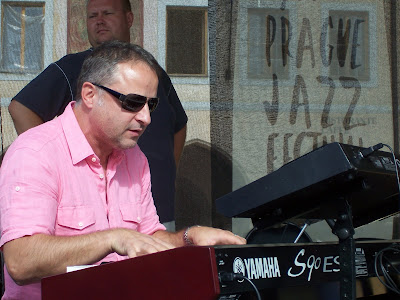


A show-stealing set from Madfinger:
Woodwind master Jiří Stivín:
Wednesday, July 9, 2008
Gig Review: Robert Balzar Trio
AghaRTA Jazz Centrum
1st July 2008
There seemed to be fewer people than usual down in the cellar as the time for music drew near. This was no reflection on the quality of the night’s entertainment; indeed the Robert Balzar Trio are one of the biggest names in Czech music. They work not only by themselves but also with pop star Dan Bárta, and they have also just released Tales, an album recorded with legendary jazz guitarist John Abercrombie. Rather it was a combination of hot weather keeping the tourists outside to be charged extortionately for beer in Wenceslas Square, and the beginning of the school holidays exiling many of the locals to the country.
Those who did come along were rewarded with a very impressive performance, even by the high standards of the RBT. There was the feeling of a band riding high, playing freely and really sparking off each other. I have seen them previously in other venues, but this concert had a more relaxed atmosphere. Joking, improvised fooling, and the occasional trick note. As the night drew on more people joined us; wandering strays and post-dinner jazz-hunters heading down into the Prague underworld to join in the fun. The chemistry was working, and this was reflected in the enthusiastic applause that the outfit received.
As usual the Trio played a good mix of standards and original material. Opening with “East Of The Sun (And West of the Moon)” (Brooks Bowman) they hit their stride early. Stanislav Mácha’s piano work was as sweet as usual. He produces the most wonderful cascades that seem to ripple up and down the keyboard forever, but never fall into being a dry technical exercise. He performs with great feeling as well as great skill; a combination that sums up what the RBT is about.
Jiří “Mr Swing” Slavíček on drums is another virtuoso with good taste. Blessed with unusual versatility he effortlessly swaps between sticks, brushes, and fingers. Indeed some of his hand work is his most beautiful playing; subtle and delicate rhythms that focus attention without overpowering.
Drum solos show two things about a drummer. They show how fast and hard they can play, and they show how fast and hard they have the decency not to play during group performance. Slavíček wins on both counts. When he lets rip it is spectacular, but it also shows that his normal playing has control, subtlety, and a selflessness that is alien to a lot of drummers.
Non-original highlights of the night included “One Night At Ken And Jessica's” (Michel Petrucciani), their emotive interpretation of “Still Crazy After All These Years” (Paul Simon), and a triumphant rattle through crowd favourite “On Green Dolphin Street” (Bronislav Kapar). The track has steadily migrated from the opener to the last song of the main set, and the rhythmic pulse of Balzar’s bass that kicks it off always gets feet tapping.
Sizable chunks of the evening’s repertoire were understandably taken from Tales, a stunning and important album that will be reviewed here shortly. “Tale” (Balzar) is a majestic and sprawling epic, and listening to it leaves you feeling that the last ten minutes of your life were truly worthwhile. “Remember Hymn” (Abercrombie) is a fragile piece of introspection that gains its power as much from the moments of silence as the moments of sound. “Black Cat White Dog” (Balzar) was explosive as ever, with its uncountable rhythms and rollercoaster swings.
Balzar is an effective bandleader as well as an innovative composer. The acoustic bass is not a natural lead instrument but he manages to make it as vigorous as any guitar or saxophone. Playing furiously during the refrains, and soloing with an agility that makes my fingers hurt just watching, he is a charismatic and dynamic performer. Pulling deep and woody tones from deep within the instrument, loaded with seasoned power, his commitment to the music is absolute.
As usual the night ended with the gorgeous “Ben-In-Jam” (Balzar), which features some spectacular work with the bow and is a complex piece but with a main theme so catchy that it is hard to forget, even after one listening. An extended outro, completed by a simple flourish, brought yet more adulation. Good music brilliantly played, to an appreciative audience, in a great little club. If every city could deliver this the world would be a better place.
1st July 2008
There seemed to be fewer people than usual down in the cellar as the time for music drew near. This was no reflection on the quality of the night’s entertainment; indeed the Robert Balzar Trio are one of the biggest names in Czech music. They work not only by themselves but also with pop star Dan Bárta, and they have also just released Tales, an album recorded with legendary jazz guitarist John Abercrombie. Rather it was a combination of hot weather keeping the tourists outside to be charged extortionately for beer in Wenceslas Square, and the beginning of the school holidays exiling many of the locals to the country.
Those who did come along were rewarded with a very impressive performance, even by the high standards of the RBT. There was the feeling of a band riding high, playing freely and really sparking off each other. I have seen them previously in other venues, but this concert had a more relaxed atmosphere. Joking, improvised fooling, and the occasional trick note. As the night drew on more people joined us; wandering strays and post-dinner jazz-hunters heading down into the Prague underworld to join in the fun. The chemistry was working, and this was reflected in the enthusiastic applause that the outfit received.
As usual the Trio played a good mix of standards and original material. Opening with “East Of The Sun (And West of the Moon)” (Brooks Bowman) they hit their stride early. Stanislav Mácha’s piano work was as sweet as usual. He produces the most wonderful cascades that seem to ripple up and down the keyboard forever, but never fall into being a dry technical exercise. He performs with great feeling as well as great skill; a combination that sums up what the RBT is about.
Jiří “Mr Swing” Slavíček on drums is another virtuoso with good taste. Blessed with unusual versatility he effortlessly swaps between sticks, brushes, and fingers. Indeed some of his hand work is his most beautiful playing; subtle and delicate rhythms that focus attention without overpowering.
Drum solos show two things about a drummer. They show how fast and hard they can play, and they show how fast and hard they have the decency not to play during group performance. Slavíček wins on both counts. When he lets rip it is spectacular, but it also shows that his normal playing has control, subtlety, and a selflessness that is alien to a lot of drummers.
Non-original highlights of the night included “One Night At Ken And Jessica's” (Michel Petrucciani), their emotive interpretation of “Still Crazy After All These Years” (Paul Simon), and a triumphant rattle through crowd favourite “On Green Dolphin Street” (Bronislav Kapar). The track has steadily migrated from the opener to the last song of the main set, and the rhythmic pulse of Balzar’s bass that kicks it off always gets feet tapping.
Sizable chunks of the evening’s repertoire were understandably taken from Tales, a stunning and important album that will be reviewed here shortly. “Tale” (Balzar) is a majestic and sprawling epic, and listening to it leaves you feeling that the last ten minutes of your life were truly worthwhile. “Remember Hymn” (Abercrombie) is a fragile piece of introspection that gains its power as much from the moments of silence as the moments of sound. “Black Cat White Dog” (Balzar) was explosive as ever, with its uncountable rhythms and rollercoaster swings.
Balzar is an effective bandleader as well as an innovative composer. The acoustic bass is not a natural lead instrument but he manages to make it as vigorous as any guitar or saxophone. Playing furiously during the refrains, and soloing with an agility that makes my fingers hurt just watching, he is a charismatic and dynamic performer. Pulling deep and woody tones from deep within the instrument, loaded with seasoned power, his commitment to the music is absolute.
As usual the night ended with the gorgeous “Ben-In-Jam” (Balzar), which features some spectacular work with the bow and is a complex piece but with a main theme so catchy that it is hard to forget, even after one listening. An extended outro, completed by a simple flourish, brought yet more adulation. Good music brilliantly played, to an appreciative audience, in a great little club. If every city could deliver this the world would be a better place.
Wednesday, July 2, 2008
Gig Review: Luboš Andršt Group
AghaRTA Jazz Centrum
24th June 2008
With ten minutes to go the audience was getting settled in, I was halfway through a bottle of decent red, and attention was starting to turn to the cellar’s modest stage. I wondered at that point if I was the only person who knew that half the band was missing. Drums and piano were set up and in place, but where the piles of bass gear and guitars should have been there was nothing but nothing.
Thankfully a flurry of activity brought the missing musicians through the doors at the last moment: Luboš and bassist “Wimpy” Tichota had been gigging elsewhere during the afternoon, and had got caught up in the traffic jams that can sometimes snarl the roads back to Prague. A few relieved looks were shared, and amps and cables hurriedly dropped into place. So for half the band this was the second gig of the day, coming after a frustrating car journey, and with a delayed start. Not quite the perfect scenario.
One of the enjoyable things about many bands that play on this scene, including of course the LAG, is that they are still willing to push it. They are all expert musicians, and it would be easy enough for them to go out and perform a perfectly prepared repertory show with not a note out of place and all the vigour of a corpse. There is no need for them to actually break into a sweat. However, that is certainly what this outfit doesn’t do, and their opening Duke Ellington salvo was delivered with force and aggression, instantly removing any grumbles that could have been brewing in the minds of the punters. It was worth the wait, and you could sense the joint approval as each of the four men took a hefty solo before the band snatched it all back together again.
Andršt originals such as “Song for Saxophone Joe” and “La Bodiguita del Medio” got a full workout; the latter being a high-energy romp with the band wheeling and sparking like madmen over clattering Cuban rhythms. Pianist Ondřej Kabrna played with particular ferocity, hammering out the melodic patterns with total commitment, seemingly on the very far edge of control. This triumphant crescendo is always warmly received, with the small cellar space hardly seeming big enough to contain the wide spectrum of sound produced.
Luboš was his normal brilliant self on guitar; a standard that is always expected and always met. His work is notable for its wide variety of sounds, incorporating blues, jazz, and also heavy shades of rock where required. Genre-spanning and unpredictable, he is a musician with depth to call upon. It is that variety, coupled with his talents as a composer and arranger, that places him in the very top rank of European musicians. The legendary BB King respected him enough to want to play with him on stage, and that is about as high as recommendations come.
The set had evolved since I last saw this outfit, with the incorporation of the crunching “Hoochie Coochie Man” instrumental section as normally played with Michal Prokop’s Framus Five. There were also changes in the extended medley that traditionally occupies a large chunk of the second set, with themes being expanded and extemporised upon by the whole group.
Drummer and AghaRTA bossman Michal Hejna was the compere for the night, introducing the songs, the band, and quite often an element of humour. With a particular flair for Latin rhythms, his work on the traps is an integral part of this live outfit. Playing later than normal in order to make up for the delayed start, he made sure that nobody left his club feeling short-changed. It was a nice touch, but in truth not required. The LAG pack more music into a single set than some outfits manage in a lifetime. Like a hearty meal they leave you with an appetite for more in the future, but for now you are just fine.
24th June 2008
With ten minutes to go the audience was getting settled in, I was halfway through a bottle of decent red, and attention was starting to turn to the cellar’s modest stage. I wondered at that point if I was the only person who knew that half the band was missing. Drums and piano were set up and in place, but where the piles of bass gear and guitars should have been there was nothing but nothing.
Thankfully a flurry of activity brought the missing musicians through the doors at the last moment: Luboš and bassist “Wimpy” Tichota had been gigging elsewhere during the afternoon, and had got caught up in the traffic jams that can sometimes snarl the roads back to Prague. A few relieved looks were shared, and amps and cables hurriedly dropped into place. So for half the band this was the second gig of the day, coming after a frustrating car journey, and with a delayed start. Not quite the perfect scenario.
One of the enjoyable things about many bands that play on this scene, including of course the LAG, is that they are still willing to push it. They are all expert musicians, and it would be easy enough for them to go out and perform a perfectly prepared repertory show with not a note out of place and all the vigour of a corpse. There is no need for them to actually break into a sweat. However, that is certainly what this outfit doesn’t do, and their opening Duke Ellington salvo was delivered with force and aggression, instantly removing any grumbles that could have been brewing in the minds of the punters. It was worth the wait, and you could sense the joint approval as each of the four men took a hefty solo before the band snatched it all back together again.
Andršt originals such as “Song for Saxophone Joe” and “La Bodiguita del Medio” got a full workout; the latter being a high-energy romp with the band wheeling and sparking like madmen over clattering Cuban rhythms. Pianist Ondřej Kabrna played with particular ferocity, hammering out the melodic patterns with total commitment, seemingly on the very far edge of control. This triumphant crescendo is always warmly received, with the small cellar space hardly seeming big enough to contain the wide spectrum of sound produced.
Luboš was his normal brilliant self on guitar; a standard that is always expected and always met. His work is notable for its wide variety of sounds, incorporating blues, jazz, and also heavy shades of rock where required. Genre-spanning and unpredictable, he is a musician with depth to call upon. It is that variety, coupled with his talents as a composer and arranger, that places him in the very top rank of European musicians. The legendary BB King respected him enough to want to play with him on stage, and that is about as high as recommendations come.
The set had evolved since I last saw this outfit, with the incorporation of the crunching “Hoochie Coochie Man” instrumental section as normally played with Michal Prokop’s Framus Five. There were also changes in the extended medley that traditionally occupies a large chunk of the second set, with themes being expanded and extemporised upon by the whole group.
Drummer and AghaRTA bossman Michal Hejna was the compere for the night, introducing the songs, the band, and quite often an element of humour. With a particular flair for Latin rhythms, his work on the traps is an integral part of this live outfit. Playing later than normal in order to make up for the delayed start, he made sure that nobody left his club feeling short-changed. It was a nice touch, but in truth not required. The LAG pack more music into a single set than some outfits manage in a lifetime. Like a hearty meal they leave you with an appetite for more in the future, but for now you are just fine.
Wednesday, June 25, 2008
News: AghaRTA Festival in August
Those fine folks at AghaRTA are putting on what could be the musical event of the year: Two free concerts in Old Town Square (9th and 10th of August) featuring some of the best musicians in Europe. Younger stars such as Matej Benko will be playing on the same bill as established Prague Jazz legends, including Emil Viklický and Luboš Andršt!
The weather should be hot, the music will be cool, and life should be very good indeed. You would be a bloody fool not to go.
If that isn't enough, AghaRTA Jazz Centrum will be also featuring a week of concerts by young women in jazz, including the fabulous Pavla Milcová.
Details can be found at http://www.agharta.cz/index.php?p=program&site=agharta_apjf
The weather should be hot, the music will be cool, and life should be very good indeed. You would be a bloody fool not to go.
If that isn't enough, AghaRTA Jazz Centrum will be also featuring a week of concerts by young women in jazz, including the fabulous Pavla Milcová.
Details can be found at http://www.agharta.cz/index.php?p=program&site=agharta_apjf
Wednesday, June 18, 2008
Gig Review: Emil Viklický Trio
AghaRTA Jazz Centrum
13th June 2008
Jazz is serious music, and serious music is serious business. Serious business requires serious people to watch a serious band while getting seriously drunk and (in the case of men only) seriously stroking their beards. Jazz doesn’t get much more serious than the Emil Viklický Trio, and yet their performance on stage is always infused with joy and fun. They are one of the finest jazz ensembles in Central Europe. They will also put a big stupid grin on your face.
It was in the cellar of AghaRTA that I first saw the EVT, and once again I ventured down those twisting stairs wondering just how that grand piano ever made the journey. Tourist season was well and truly in full swing. Some loudmouth had got his wallet stolen earlier in the day. An Australian woman said it was common in Czechoslovakia. The pickpockets must be really good if they can hit a tourist almost two decades after their country of work ceased to exist. But for all the inane chatter this club does tend to bring in the more knowledgeable class of fool, and silence during the three sets was refreshingly observed.
It would have been hard to talk during the music though. At least for anyone who wasn’t dead from the soul up, for three maestros were doing their stuff, and doing it in style. The Trio consists of EV on piano, Laco Tropp on drums, and František Uhlíř on acoustic bass. With over a century of playing experience between them they have every trick in the book to call upon, and yet when performing they have the vigour of a bunch of teenagers. This is no hackneyed reparatory for the punters; they are for real.
Viklický, as befits a native of the fine wine-drinking town of Olomouc, has made a name for himself with music inspired by Moravian folk songs. He manages to capture the spirit of these lilting melodies and alloy them into his own arrangements. The results are usually complex, timeless, and achingly beautiful. His original “Highlands, Lowlands” is one of the most perfect pieces of music I have ever heard, with its descending bitter-sweet motif cascading out of variations galore and bringing you back home after each adventurous journey. Similarly, “Wine, Oh Wine” (you can tell he is from Moravia, not Bohemia!) retains an essential simplicity and echoes sentiments from the other end of the country.
There are times when the vitality you see is in contrast with the music you hear; gentle piano phrases dripping in minor tones and darkness. He never goes too far though, and he is capable of snapping you out of it (just before you have to start pretending that you’ve got smoke in your eye) by wheeling into a brief big band boogie arrangement that makes you wonder where the stripper is.
Fun really is the order of the day. Viklický slides and squirms on his stool as he pounds the keys: a fine exponent of whole-body playing. Sometimes he jumps up and he is, to date, the only jazz pianist here I’ve seen play even a few notes whilst on his feet. Occasionally he reaches inside the body of the grand and ends a song with a playful plink, directly on the strings. He’s into it, and it is very hard for anyone watching to remain detached.
Emil is not the only showman on stage though. František Uhlíř is an exciting bassist to watch. He does all the quick stuff that you would expect, but he also compliments his musical vocabulary with funky thumb slaps and long slides up and down the neck that produce a resounding quivering twang. Uhlíř is also an accomplished composer in his own right, and his “Father’s Blues” was given a thorough workout.
Tropp on drums is no slouch either, but one of the joys of listening to a grownup drummer is that they know when to play and when to shut up. With nothing to prove he is not afraid to back off and leave room, making it all the sweeter when he does give it some serious boot. He is also the band’s resident linguist, enthusiastically converting Czech and English song titles into German and Hungarian.
As sometimes occurs, in this city of adaptable jamming musicians, Emil had a special guest with him for one song. His granddaughter, Tamarka, was in town and she joined him on vocals for one song. Sweetly delivered, she has a stage presence that defies her tender years. One wonders when her first album will be out.
The trio played three sets, and that is a lot of music, but they never threatened to go flaccid in the middle. Their final blast of “Buhaina, Buhaina” (Brown) was a jaunty kick into the night, and the band received one of the warmest rounds of applause I have heard in a while.
Three supreme musicians. Three characters on stage. Three men who truly understand the shape and form of music. A trio of reasons to go and see the Trio. They play complex material and do it so well that it all seems so perfectly simple. They play songs full of yearning that leave you satisfied. And most of all they will make you smile. In this world that can count for a lot.
13th June 2008
Jazz is serious music, and serious music is serious business. Serious business requires serious people to watch a serious band while getting seriously drunk and (in the case of men only) seriously stroking their beards. Jazz doesn’t get much more serious than the Emil Viklický Trio, and yet their performance on stage is always infused with joy and fun. They are one of the finest jazz ensembles in Central Europe. They will also put a big stupid grin on your face.
It was in the cellar of AghaRTA that I first saw the EVT, and once again I ventured down those twisting stairs wondering just how that grand piano ever made the journey. Tourist season was well and truly in full swing. Some loudmouth had got his wallet stolen earlier in the day. An Australian woman said it was common in Czechoslovakia. The pickpockets must be really good if they can hit a tourist almost two decades after their country of work ceased to exist. But for all the inane chatter this club does tend to bring in the more knowledgeable class of fool, and silence during the three sets was refreshingly observed.
It would have been hard to talk during the music though. At least for anyone who wasn’t dead from the soul up, for three maestros were doing their stuff, and doing it in style. The Trio consists of EV on piano, Laco Tropp on drums, and František Uhlíř on acoustic bass. With over a century of playing experience between them they have every trick in the book to call upon, and yet when performing they have the vigour of a bunch of teenagers. This is no hackneyed reparatory for the punters; they are for real.
Viklický, as befits a native of the fine wine-drinking town of Olomouc, has made a name for himself with music inspired by Moravian folk songs. He manages to capture the spirit of these lilting melodies and alloy them into his own arrangements. The results are usually complex, timeless, and achingly beautiful. His original “Highlands, Lowlands” is one of the most perfect pieces of music I have ever heard, with its descending bitter-sweet motif cascading out of variations galore and bringing you back home after each adventurous journey. Similarly, “Wine, Oh Wine” (you can tell he is from Moravia, not Bohemia!) retains an essential simplicity and echoes sentiments from the other end of the country.
There are times when the vitality you see is in contrast with the music you hear; gentle piano phrases dripping in minor tones and darkness. He never goes too far though, and he is capable of snapping you out of it (just before you have to start pretending that you’ve got smoke in your eye) by wheeling into a brief big band boogie arrangement that makes you wonder where the stripper is.
Fun really is the order of the day. Viklický slides and squirms on his stool as he pounds the keys: a fine exponent of whole-body playing. Sometimes he jumps up and he is, to date, the only jazz pianist here I’ve seen play even a few notes whilst on his feet. Occasionally he reaches inside the body of the grand and ends a song with a playful plink, directly on the strings. He’s into it, and it is very hard for anyone watching to remain detached.
Emil is not the only showman on stage though. František Uhlíř is an exciting bassist to watch. He does all the quick stuff that you would expect, but he also compliments his musical vocabulary with funky thumb slaps and long slides up and down the neck that produce a resounding quivering twang. Uhlíř is also an accomplished composer in his own right, and his “Father’s Blues” was given a thorough workout.
Tropp on drums is no slouch either, but one of the joys of listening to a grownup drummer is that they know when to play and when to shut up. With nothing to prove he is not afraid to back off and leave room, making it all the sweeter when he does give it some serious boot. He is also the band’s resident linguist, enthusiastically converting Czech and English song titles into German and Hungarian.
As sometimes occurs, in this city of adaptable jamming musicians, Emil had a special guest with him for one song. His granddaughter, Tamarka, was in town and she joined him on vocals for one song. Sweetly delivered, she has a stage presence that defies her tender years. One wonders when her first album will be out.
The trio played three sets, and that is a lot of music, but they never threatened to go flaccid in the middle. Their final blast of “Buhaina, Buhaina” (Brown) was a jaunty kick into the night, and the band received one of the warmest rounds of applause I have heard in a while.
Three supreme musicians. Three characters on stage. Three men who truly understand the shape and form of music. A trio of reasons to go and see the Trio. They play complex material and do it so well that it all seems so perfectly simple. They play songs full of yearning that leave you satisfied. And most of all they will make you smile. In this world that can count for a lot.
Saturday, April 12, 2008
Gig Review: Allan Holdsworth Band
Lucerna Music Bar (AghaRTA Jazz Festival)
6th April 2008
Allan Holdsworth is one of the modern masters of the guitar, with a list of recordings and collaborations as long as one of his trademark liquid solos. A fusioneer who started out in Progressive Rock, he has worked with Bill Bruford, Soft Machine, Jean-Luc Ponty, Jack Bruce, and many other greats. Experimental and experimenting, Holdsworth is revered amongst those who take their guitar appreciation seriously.
The Lucerna Music Bar is revered by those who like cheap beer and things that smell of smoke. A circular stage, surrounded by chairs and tables that are awarded on a first-come-first-sit basis, dominates this lovably shabby cellar. Serious jazz types mix it with long-haired experimental rock aficionados. A small group of people who look like liberals sneakily eat a sandwich they've smuggled in and nurse one small bottle of fruit juice between them. The lights go down and we’re ready for some hardcore Holdsworth action. And then Jeff Aug steps out, with an acoustic six-string, and hammers seven shades of shale out of it.
Support acts usually have only one purpose and that is to suck. They’re the ugly friend you go to the bar with when you’re out to score. They’re the bad stats you give the boss before you present him with the report on how you are going to save the company. They have a place in life, a rung on the ladder, and they’d better not blow the main act out of the water.
It is a brave lead guitarist who has Jeff Aug open for him. Playing what can only be described as high-speed country funk, he shreds his way up and down the strings with breathtaking speed. He also provides his own percussion, striking the body of the instrument hard enough to sound like a bass drum. This is extreme acoustic guitar, and extremely good, rendering the audience unusually silent.
After Aug’s set, and more time for beer, it was the turn of Allan Holdworth and his trio, with Jimmy Johnson on bass and Chad Wackerman on drums. Allan himself took to the stage with a guitar synthesiser; a small enough instrument anyway but almost comically tiny when compared with his enormous hands. If you’ve ever wondered how he gets those chords, giant hands help!
They blasted off at one hundred miles per hour, and stayed there. And this was the problem. Three virtuoso musicians. Three soloists. And nobody leaving any space. Wackerman was the main offender: he is a brilliant and talented drummer, but he was far too loud in the mix and he would never shut up. Instead of being able to concentrate and savour Allan’s brilliant playing it was a battle to focus on the sound. He was almost pathologically frightened of leaving anything unhit.
Cacophony is good but only as part of a contrast with calm, and it was this contrast that the gig lacked. There was no counterpoint, no variation. There was no tension and release. The band was always so cranked up that it had nowhere to go for emphasis; no extra gear to shift into to hammer home the point.
The few quieter moments were dominated by Holdsworth’s electronic soundscapes, lushly textured and assiduously crafted walls of sound driven through delays and effects. But these were few and far between, before the assault started again. As well as being aurally interesting they provided a sense of relief and a time to recover before the next bombastic free-for-all.
It was like watching a great artist painting only in one colour. The technical skills were beyond reproach but something was missing. Maybe this was not a good night, or maybe it was the house mix that nominated the drums as a lead instrument. Or maybe constant cacophony was the aim.
These are three fantastic musicians, but unless you’re particularly dedicated to one of them, or extreme experimental fusion floats your boat, then you may be disappointed. However if you get a chance to see Jeff Aug you should do so!
Websites:
http://www.jeffaug.com/
http://www.therealallanholdsworth.com/
6th April 2008
Allan Holdsworth is one of the modern masters of the guitar, with a list of recordings and collaborations as long as one of his trademark liquid solos. A fusioneer who started out in Progressive Rock, he has worked with Bill Bruford, Soft Machine, Jean-Luc Ponty, Jack Bruce, and many other greats. Experimental and experimenting, Holdsworth is revered amongst those who take their guitar appreciation seriously.
The Lucerna Music Bar is revered by those who like cheap beer and things that smell of smoke. A circular stage, surrounded by chairs and tables that are awarded on a first-come-first-sit basis, dominates this lovably shabby cellar. Serious jazz types mix it with long-haired experimental rock aficionados. A small group of people who look like liberals sneakily eat a sandwich they've smuggled in and nurse one small bottle of fruit juice between them. The lights go down and we’re ready for some hardcore Holdsworth action. And then Jeff Aug steps out, with an acoustic six-string, and hammers seven shades of shale out of it.
Support acts usually have only one purpose and that is to suck. They’re the ugly friend you go to the bar with when you’re out to score. They’re the bad stats you give the boss before you present him with the report on how you are going to save the company. They have a place in life, a rung on the ladder, and they’d better not blow the main act out of the water.
It is a brave lead guitarist who has Jeff Aug open for him. Playing what can only be described as high-speed country funk, he shreds his way up and down the strings with breathtaking speed. He also provides his own percussion, striking the body of the instrument hard enough to sound like a bass drum. This is extreme acoustic guitar, and extremely good, rendering the audience unusually silent.
After Aug’s set, and more time for beer, it was the turn of Allan Holdworth and his trio, with Jimmy Johnson on bass and Chad Wackerman on drums. Allan himself took to the stage with a guitar synthesiser; a small enough instrument anyway but almost comically tiny when compared with his enormous hands. If you’ve ever wondered how he gets those chords, giant hands help!
They blasted off at one hundred miles per hour, and stayed there. And this was the problem. Three virtuoso musicians. Three soloists. And nobody leaving any space. Wackerman was the main offender: he is a brilliant and talented drummer, but he was far too loud in the mix and he would never shut up. Instead of being able to concentrate and savour Allan’s brilliant playing it was a battle to focus on the sound. He was almost pathologically frightened of leaving anything unhit.
Cacophony is good but only as part of a contrast with calm, and it was this contrast that the gig lacked. There was no counterpoint, no variation. There was no tension and release. The band was always so cranked up that it had nowhere to go for emphasis; no extra gear to shift into to hammer home the point.
The few quieter moments were dominated by Holdsworth’s electronic soundscapes, lushly textured and assiduously crafted walls of sound driven through delays and effects. But these were few and far between, before the assault started again. As well as being aurally interesting they provided a sense of relief and a time to recover before the next bombastic free-for-all.
It was like watching a great artist painting only in one colour. The technical skills were beyond reproach but something was missing. Maybe this was not a good night, or maybe it was the house mix that nominated the drums as a lead instrument. Or maybe constant cacophony was the aim.
These are three fantastic musicians, but unless you’re particularly dedicated to one of them, or extreme experimental fusion floats your boat, then you may be disappointed. However if you get a chance to see Jeff Aug you should do so!
Websites:
http://www.jeffaug.com/
http://www.therealallanholdsworth.com/
Friday, March 28, 2008
Gig Review: Luboš Andršt Group
AghaRTA Jazz Centrum
18th March 2008
Of all the groups that play regularly on the Prague scene, the LAG are probably my favourite. They combine jazz with blues, and even intelligent touches of rock here and there. As such they have their own sound, unique to this ensemble. Of all Andršt’s current projects this is probably the most adventurous and, while accessible, there is a distinct flavour of musician’s musicians about the band. That’s not to say that they are self-indulgent (although that’s not the sin that some like to pretend that it is), but the pieces are complex, multi-layered, richly textured, and occasionally knowingly but wryly showy. Above all these guys play hard. Real hard.
Andršt is one of the best guitarists in Central Europe, and has frequently appeared on the wider radar. Check out YouTube for his duet with B.B. King. He has the stature and demeanour of a proper guitarist: a traditional axe-man of the old school who looks like he belongs on stage, says little, and plays loud. A musical heavyweight, he not only has the chops and the taste but he also is a remarkable writer. The bulk of the LAG’s set is his own material, and this emphasises the quality of the guy’s work, and is also what sets him apart from many able guitarists on the Czech scene.
The Group features the maniacal keyboard work of Ondřej Kabrna, a young player of outstanding ability who loses himself totally in the moment. His instrument is not something he plays but an extension of his physical form and he embraces, caresses, and occasionally pounds and thumps the required sounds out of the yielding piano or synth. Trading leads and accompanying guitar lines, Kabrna’s input shapes the sound greatly, as does the six-string electric bass work of “Wimpy” Tichota. An inventive and solid bassist, he is capable of slapping out a damn good solo when the mood takes him.
The importance of Kabrna and Wimpy in the band can be heard by comparing their live renditions of tracks such as “Wide Open Door” and “Song for Saxophone Joe” with the studio versions on the Acoustic Set album (1996). A fine and splendid album but, with vibes instead of piano and acoustic instead of electric bass, it lacks the sheer balls of this live line-up. Indeed, the piano lines added to “Saxophone Joe” by Kabrna utterly transform it, rendering it into a swirling masterpiece. None of the subtlety of the originals is lost, and indeed the current live LAG’s “Follow Your Heart” is more even aching than the sensitively played album track, but there is just an extra bucket of whack available for use when required.
The other musician (apart from LA) who also played on Acoustic Set is drummer and Prague music kingpin Michal Hejna. Now Michal, and this is meant nicely, is not a little chap. As a not little chap myself I feel I can say this. But this guy can move with a speed and fluidity that would leave youngsters and gym-monkeys shaking their heads. Powerful yet nimble, he has a flair for complex drum patterns and a nice line in jolly Latin rattles and shakes, excellently exhibited on Cuban-influenced “La Bodiguita del Medio”.
With a splash of B.B. King and jazz standards in the proceedings, the LAG played a balanced and inventive set. They’re not afraid to expand on ideas and develop the music into extended and satisfyingly segued pieces. Acoustic Set is available from the club’s shop and it is a great piece of music. But this, the live, electrified treatment of the tracks, is even better. This gig proved once again that LAG are one of Prague’s must-see bands. They are also one of the very few bands that would genuinely make the world a better place by releasing a double live album!
18th March 2008
Of all the groups that play regularly on the Prague scene, the LAG are probably my favourite. They combine jazz with blues, and even intelligent touches of rock here and there. As such they have their own sound, unique to this ensemble. Of all Andršt’s current projects this is probably the most adventurous and, while accessible, there is a distinct flavour of musician’s musicians about the band. That’s not to say that they are self-indulgent (although that’s not the sin that some like to pretend that it is), but the pieces are complex, multi-layered, richly textured, and occasionally knowingly but wryly showy. Above all these guys play hard. Real hard.
Andršt is one of the best guitarists in Central Europe, and has frequently appeared on the wider radar. Check out YouTube for his duet with B.B. King. He has the stature and demeanour of a proper guitarist: a traditional axe-man of the old school who looks like he belongs on stage, says little, and plays loud. A musical heavyweight, he not only has the chops and the taste but he also is a remarkable writer. The bulk of the LAG’s set is his own material, and this emphasises the quality of the guy’s work, and is also what sets him apart from many able guitarists on the Czech scene.
The Group features the maniacal keyboard work of Ondřej Kabrna, a young player of outstanding ability who loses himself totally in the moment. His instrument is not something he plays but an extension of his physical form and he embraces, caresses, and occasionally pounds and thumps the required sounds out of the yielding piano or synth. Trading leads and accompanying guitar lines, Kabrna’s input shapes the sound greatly, as does the six-string electric bass work of “Wimpy” Tichota. An inventive and solid bassist, he is capable of slapping out a damn good solo when the mood takes him.
The importance of Kabrna and Wimpy in the band can be heard by comparing their live renditions of tracks such as “Wide Open Door” and “Song for Saxophone Joe” with the studio versions on the Acoustic Set album (1996). A fine and splendid album but, with vibes instead of piano and acoustic instead of electric bass, it lacks the sheer balls of this live line-up. Indeed, the piano lines added to “Saxophone Joe” by Kabrna utterly transform it, rendering it into a swirling masterpiece. None of the subtlety of the originals is lost, and indeed the current live LAG’s “Follow Your Heart” is more even aching than the sensitively played album track, but there is just an extra bucket of whack available for use when required.
The other musician (apart from LA) who also played on Acoustic Set is drummer and Prague music kingpin Michal Hejna. Now Michal, and this is meant nicely, is not a little chap. As a not little chap myself I feel I can say this. But this guy can move with a speed and fluidity that would leave youngsters and gym-monkeys shaking their heads. Powerful yet nimble, he has a flair for complex drum patterns and a nice line in jolly Latin rattles and shakes, excellently exhibited on Cuban-influenced “La Bodiguita del Medio”.
With a splash of B.B. King and jazz standards in the proceedings, the LAG played a balanced and inventive set. They’re not afraid to expand on ideas and develop the music into extended and satisfyingly segued pieces. Acoustic Set is available from the club’s shop and it is a great piece of music. But this, the live, electrified treatment of the tracks, is even better. This gig proved once again that LAG are one of Prague’s must-see bands. They are also one of the very few bands that would genuinely make the world a better place by releasing a double live album!
Friday, March 14, 2008
Gig Review: Pavla Milcová & Tarzan Pepé
AghaRTA Jazz Centrum
8th March 2008
I am not going to start by saying that Pavla Milcová reminded me of Joni Mitchell; not because at times she didn’t, but because that is just lazy. Every pretty girl with a guitar and an intelligent take on songwriting gets compared to Mitchell, and such an original artist as this deserves a better crafted review. Similarly, the word “quirky” could be chucked in at this point, but it won’t be. It gets thrown around a lot with creative female singer-songwriters, and it is usually just a euphemism for “bonkers”. I talked briefly to this lady and she is not actually bonkers. I can usually spot them a mile off.
What Pavla Milcová has is something that I have not heard for a long time, and that is a sound that is genuinely original; something new under the sun is a rare and precious thing. There are overlaps and influences, revealed either by design or by chance, but every time you think you’ve got her nailed down into a convenient category she nimbly steps aside, usually with a laugh. This was jazzy folk (or folky jazz) in a wide horizon context. Shakespeare’s Sonnet 66 as an aching duet between her and multi-instrumentalist Peter Binder. Gershwin with a kazoo and cute mime. A deliciously whiter shade of Procol Harum woven seamlessly into the enchanting original “Rosemary”.
Many of the original Milcová/Binder compositions were notably strong: The life-affirming rhythmic romp of “Otče!”, the beautifully fragile-yet-impassioned vocal lines of “My Country”, and the timeless lilt of “Good bye” were particular highlights.
Her three-piece “Tarzan Pepé” outfit is well balanced on stage. Peter Binder leads the band musically with his jazzy and intricate electric guitar style, delivered in good uniformly good taste. Effects are used sparingly, and there’s just enough flash in his fingers to suggest that he could burn fast all night but doesn’t actually want to. Occasionally venturing to the piano, (treated with the same degree of sensitivity) and throwing in some backing vocals to boot, Binder’s work ensures that the music is serious fun. On acoustic bass the able fingers of Jaromír Honzák acted as an anchor and echo of the melody, and he was occasionally let off the leash for a crowd-pleasing string-slapping solo.
Ms. Milcová herself was usually busy with rhythm guitar, kazoo, or sea-shell percussion, all played with infectious gusto. A lot of the pieces were taken from her Pavla Milcová & Tarzan Pepé (1999) and Mentolový Král (2006) albums, with lyrics mainly in Czech. This, coupled with her all-Czech banter, made sure that the atmosphere was that of a real gig rather than a carnival sideshow for the passing international tourist trade.
Unlike many Prague musicians she does not appear in one of the local clubs on a weekly basis, and so her concerts are an event worth clearing the diary for. It is not often that you get surprised by a performance, and it is even less often that surprises are so pleasant. There is folk. There is jazz. There is fun and there is pain. There is intelligence. There is Shakepeare and prog rock. There is kazoo. There is a beautiful voice. And somehow you feel that for once there is something new under the sun.
Website: http://www.pavlamilcova.com/
8th March 2008
I am not going to start by saying that Pavla Milcová reminded me of Joni Mitchell; not because at times she didn’t, but because that is just lazy. Every pretty girl with a guitar and an intelligent take on songwriting gets compared to Mitchell, and such an original artist as this deserves a better crafted review. Similarly, the word “quirky” could be chucked in at this point, but it won’t be. It gets thrown around a lot with creative female singer-songwriters, and it is usually just a euphemism for “bonkers”. I talked briefly to this lady and she is not actually bonkers. I can usually spot them a mile off.
What Pavla Milcová has is something that I have not heard for a long time, and that is a sound that is genuinely original; something new under the sun is a rare and precious thing. There are overlaps and influences, revealed either by design or by chance, but every time you think you’ve got her nailed down into a convenient category she nimbly steps aside, usually with a laugh. This was jazzy folk (or folky jazz) in a wide horizon context. Shakespeare’s Sonnet 66 as an aching duet between her and multi-instrumentalist Peter Binder. Gershwin with a kazoo and cute mime. A deliciously whiter shade of Procol Harum woven seamlessly into the enchanting original “Rosemary”.
Many of the original Milcová/Binder compositions were notably strong: The life-affirming rhythmic romp of “Otče!”, the beautifully fragile-yet-impassioned vocal lines of “My Country”, and the timeless lilt of “Good bye” were particular highlights.
Her three-piece “Tarzan Pepé” outfit is well balanced on stage. Peter Binder leads the band musically with his jazzy and intricate electric guitar style, delivered in good uniformly good taste. Effects are used sparingly, and there’s just enough flash in his fingers to suggest that he could burn fast all night but doesn’t actually want to. Occasionally venturing to the piano, (treated with the same degree of sensitivity) and throwing in some backing vocals to boot, Binder’s work ensures that the music is serious fun. On acoustic bass the able fingers of Jaromír Honzák acted as an anchor and echo of the melody, and he was occasionally let off the leash for a crowd-pleasing string-slapping solo.
Ms. Milcová herself was usually busy with rhythm guitar, kazoo, or sea-shell percussion, all played with infectious gusto. A lot of the pieces were taken from her Pavla Milcová & Tarzan Pepé (1999) and Mentolový Král (2006) albums, with lyrics mainly in Czech. This, coupled with her all-Czech banter, made sure that the atmosphere was that of a real gig rather than a carnival sideshow for the passing international tourist trade.
Unlike many Prague musicians she does not appear in one of the local clubs on a weekly basis, and so her concerts are an event worth clearing the diary for. It is not often that you get surprised by a performance, and it is even less often that surprises are so pleasant. There is folk. There is jazz. There is fun and there is pain. There is intelligence. There is Shakepeare and prog rock. There is kazoo. There is a beautiful voice. And somehow you feel that for once there is something new under the sun.
Website: http://www.pavlamilcova.com/
Subscribe to:
Comments (Atom)